Table Of Content

If you change the original code, then the method itself looses the point because it needs to be rewritten every time someone wants to make a small change to the ship. Notice that both the classes are extending Computer super class. Let’s say we have two sub-classes PC and Server with below implementation.
Top Udemy Course: Spring Boot Thymeleaf Real-Time Web Application Course
You are developing a software system for an e-commerce platform that deals with various types of products. Each product category (e.g., electronics, clothing, books) requires specific handling during creation. However, you want to decouple the client code from the concrete product creation logic to enhance flexibility and maintainability.
Microlibrary Warak Kayu - World Architecture Community
Microlibrary Warak Kayu.
Posted: Sat, 04 Apr 2020 07:00:00 GMT [source]
Understanding the Factory Method in Java Design Patterns
Design Patterns help solve a lot of ambiguities by providing an approach to write extensible code that does not need many changes while incorporating some new additions to it. The experts in the software industry follow standard design patterns or come up with their own to make their overall process efficiency. In this article, we are going to see one of those classic design patterns called the factory design pattern.
A Dog interface
Each object is created through a factory method available in the factory - which can either be an interface or an abstract class. The Factory Method Pattern (also known as the Virtual Constructor or Factory Template Pattern) is a creational design pattern used in object-oriented languages. These are the actual implementations of the Currency interface. Each concrete product provides its own implementation of the getSymbol() method.
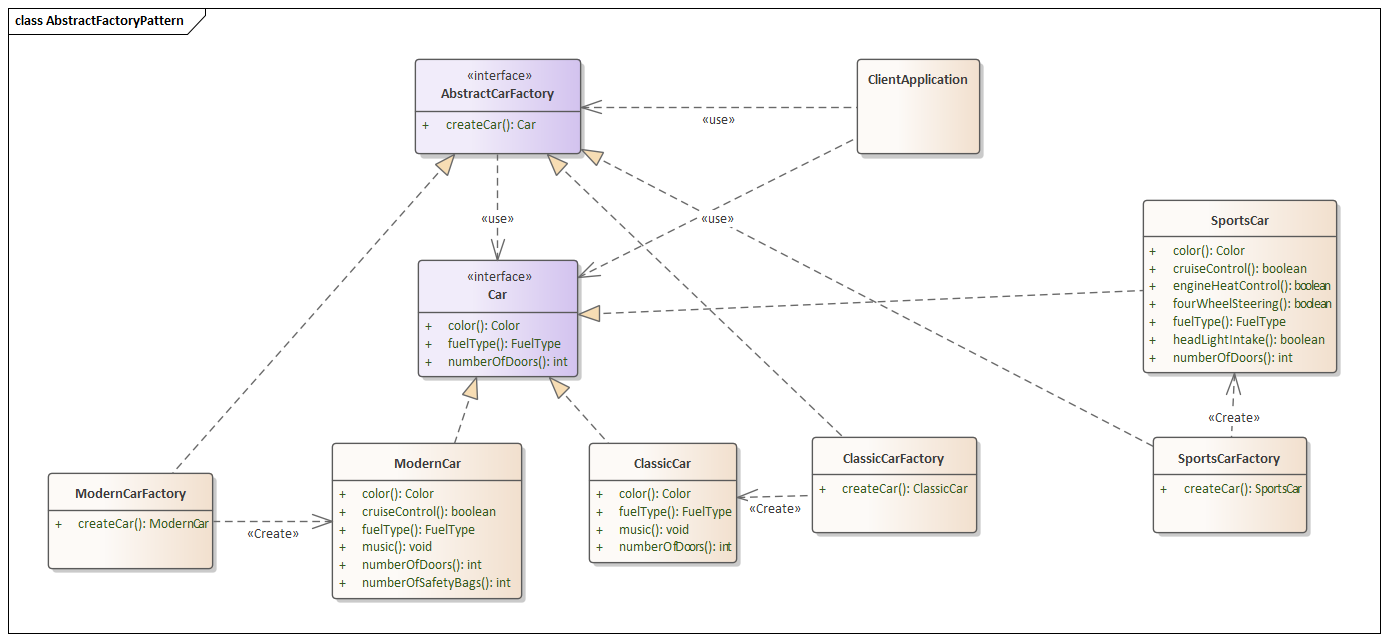
This pattern can be used to create objects of a single type, or objects of different types based on a set of conditions. In this article, we will explore the Factory Design Pattern in detail and look at its various use cases and implementation techniques. The Factory Design Pattern is a design pattern that provides a single interface for creating objects, with the implementation of the object creation process being handled by a factory class.
Since the instantiations are hard-coded, you could either create a duplicate of your original method or change its code. Specifically, the Factory Method and Abstract Factory are very common in Java software development. Through this article, I have listed what a Factory Design Pattern is and how to implement a Factory.
It is a creational design pattern that talks about the creation of an object. The factory design pattern says to define an interface ( A java interface or an abstract class) for creating the object and let the subclasses decide which class to instantiate. Let's follow a basic approach to factory design patterns and see if that is of any help. We know what you are thinking - Why use factory design pattern in Java?
A framework for merging ontologies in the context of smart factories - ScienceDirect.com
A framework for merging ontologies in the context of smart factories.
Posted: Mon, 13 Dec 2021 20:55:37 GMT [source]
My Udemy Course - Testing Spring Boot Application with JUnit and Mockito
The main idea is to define an interface or abstract class (a factory) for creating objects. Though, instead of instantiating the object, the instantiation is left to its subclasses. These patterns control the way we define and design the objects, as well as how we instantiate them.
I hope to receive contributions from everyone so that the programming community can continue to develop, and especially so that future articles can be better. Once you have written this code for ordering a drink, you realize that it needs to determine the type of drink as well. The Factory Method separates product construction code from the code that actually uses the product. Therefore it’s easier to extend the product construction code independently from the rest of the code. Imagine that you’re creating a logistics management application. The first version of your app can only handle transportation by trucks, so the bulk of your code lives inside the Truck class.
And as you’re about to see, the signature of the factory method shows that it will be returning a class which implements my base class, in this case, my Dog interface. Spice Digital Inc. company now decided to make their global presence. They want to extend their business to London and NewYork location. Looking at the market interest, London factory will produce only SpiceBolt and SpiceFire model and New York will produce SpiceFire and SpicePlus. Let us have a glance at the below class diagram that using the Factory method design pattern. For example, to add a new product type to the app, you’ll only need to create a new creator subclass and override the factory method in it.
Use the Factory Method when you don’t know beforehand the exact types and dependencies of the objects your code should work with. This example illustrates how the Factory Method can be used for creating cross-platform UI elements without coupling the client code to concrete UI classes. Subclasses can alter the class of objects being returned by the factory method.
You extend the standard Button class with a glorious RoundButton subclass. But now you need to tell the main UIFramework class to use the new button subclass instead of a default one. Of course, you can apply this approach to other UI elements as well. However, with each new factory method you add to the Dialog, you get closer to the Abstract Factory pattern.


No comments:
Post a Comment